
Cleaning businesses buy the wrong coverage more often than almost any other trade, and it is not their fault. The three things most likely to go wrong on a commercial cleaning contract are all things a standard general liability policy does not pay for.
This ranks the providers that write janitorial and commercial cleaning operations in 2026, and explains the coverage structure that actually matches how the work goes wrong. For coverage details and a quote, see our cleaning business and janitorial services pages.
The short answer: ERGO NEXT is the best value for most small cleaning companies at around $72 a month, with instant certificates. The Hartford is stronger once you have employees and commercial contracts, at about $89. biBERK is worth a look if you need liability and commercial auto together. But before you compare prices, understand that general liability alone will not satisfy a Los Angeles County property management contract, and it will not cover the claim you are most likely to have.
What General Liability Does Not Cover for Cleaners
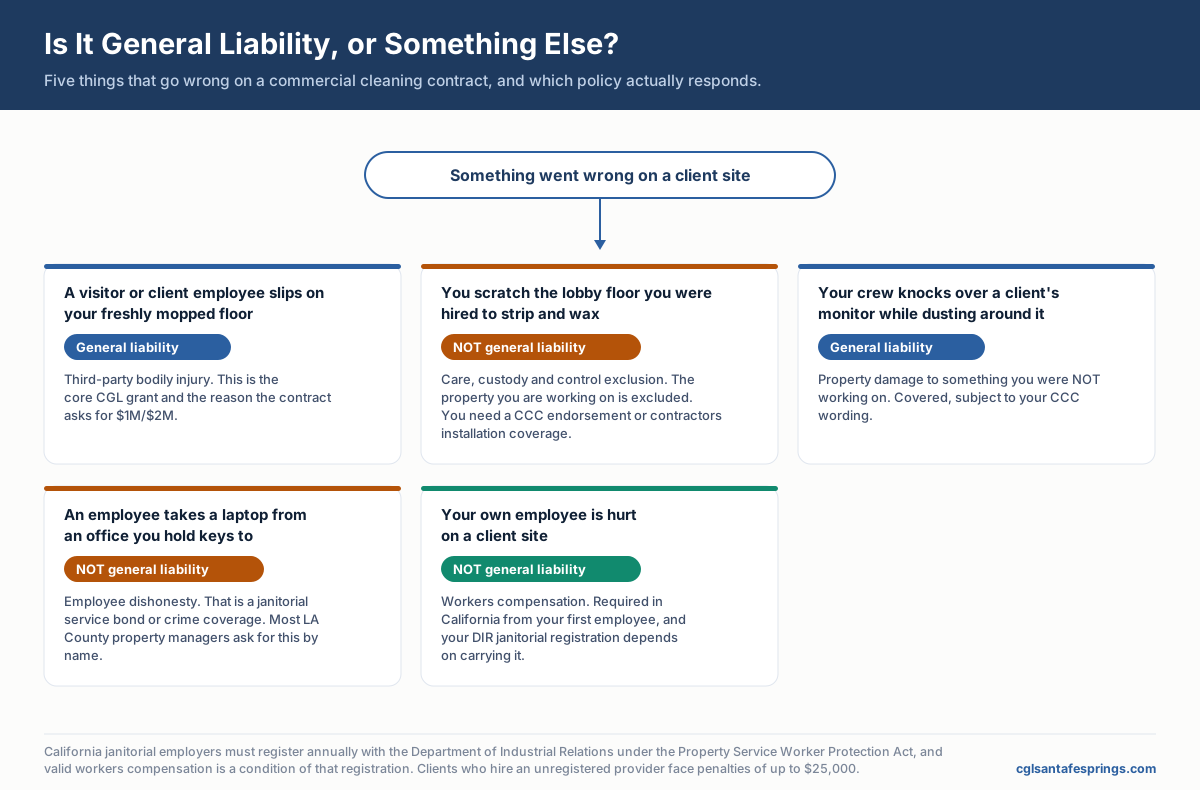
The distinction that costs cleaning businesses the most money is care, custody and control. Your general liability policy covers property damage you cause to things you were not working on. It excludes damage to the property in your care, custody, or control, which is to say the exact thing you were hired to clean.
Scratch the lobby floor you were hired to strip and wax, and that is excluded. Knock over a monitor while dusting around it, and that is covered. Clients rarely understand this distinction, and neither do most cleaning contractors until they file the claim.
The fix is a care, custody and control endorsement, sometimes written as contractors installation or a limited property damage extension depending on the carrier. It is not expensive. It is also not automatic, and no online quote flow will ask you about it.
The second gap is employee dishonesty. If your crew holds keys to a client's building and something goes missing, that is theft by an employee, which general liability excludes. What responds is a janitorial service bond or crime coverage. LA County property managers know this and ask for it by name, which is why cleaning contractors who show up with general liability alone lose bids to competitors who brought the whole package.
The California Registration Requirement That Gates Your Contracts
This is the single most important compliance fact for a California cleaning business, and most rankings never mention it.
Under the Property Service Worker Protection Act, janitorial employers in California must register annually with the Department of Industrial Relations. Registration requires demonstrating valid and adequate workers compensation insurance. Since January 1, 2019, janitorial employers must also provide biennial in-person sexual violence and harassment prevention training to all janitorial workers.
The part that changes how clients behave: a client who contracts with an unregistered janitorial provider faces penalties of up to $25,000.
That is why a property manager in Downey or Long Beach will ask for your DIR registration number before your certificate of insurance. They are not being difficult. They are avoiding a five-figure fine. Registration is verifiable in a public DIR database, and sophisticated clients check it at every contract renewal.
The chain runs in one direction: no workers compensation means no DIR registration, and no registration means the commercial contracts are closed to you regardless of what your general liability policy says.
A few categories are excluded from the registration requirement, including window washers, housekeepers who primarily change linens, workers who primarily assemble and disassemble equipment, and those maintaining sterile facilities. Single residential cleaners are generally exempt. If you clean commercial buildings in LA County, you are almost certainly covered by it.
What Cleaning Businesses Pay in Los Angeles County
| Operation type | Typical monthly GL | Typical annual | Main rating driver |
|---|---|---|---|
| Solo residential cleaner | $70 - $140 | $840 - $1,680 | Revenue, homes per week |
| Small residential crew (2-4) | $85 - $165 | $1,020 - $1,980 | Payroll |
| Commercial office cleaning | $75 - $155 | $900 - $1,860 | Square footage cleaned, after-hours access |
| Janitorial with key holding | $95 - $185 | $1,140 - $2,220 | Number of client buildings, crime coverage |
| Post-construction cleanup | $130 - $270 | $1,560 - $3,240 | Job site exposure, classified closer to a trade |
| Pressure washing added | $85 - $180 | $1,020 - $2,160 | Water intrusion and overspray |
MoneyGeek puts janitorial general liability at an average of $72 a month with ERGO NEXT, $89 with The Hartford and $90 with biBerk, against a broader cleaning industry average of about $100 a month or $1,199 a year. California sits above those national figures.
Watch the post-construction line. Cleaning contractors who take construction cleanup work are frequently classified into a construction class rather than a janitorial one, which roughly doubles the rate. If cleanup is a small share of your revenue, say so precisely on the application rather than letting the underwriter assume.
The Rankings
#1: ERGO NEXT
Best for: solo cleaners and small residential or light commercial operations under roughly $500,000 in revenue.
Next Insurance rebranded as ERGO NEXT in January 2026 after Munich Re's acquisition.
What stands out: around $72 a month, bound online in minutes, unlimited certificates from the dashboard. When a property manager asks for a COI naming their entity before Monday, you can produce it Friday afternoon.
Drawbacks: the certificate wording is standard. Care, custody and control and janitorial bonds are not part of the automated flow, so the two coverages you most need are the two you are most likely to skip.
#2: The Hartford
Best for: cleaning companies with employees, multiple commercial contracts, and property management clients.
What stands out: about $89 a month with agent support, broad liability forms, and the ability to place general liability, workers compensation, crime, and commercial auto with one carrier. Since your DIR registration depends on workers compensation, having liability and comp on the same paper with the same renewal date removes a real failure point.
Drawbacks: priced above the digital carriers, and certificates take 24 to 48 hours.
#3: CGL Santa Fe Springs
Best for: commercial cleaning and janitorial contractors working the Southeast LA County industrial corridor.
What stands out: the whole package placed together. General liability with a care, custody and control endorsement, a janitorial service bond, and certificates written to the exact wording a property management company demands, issued same day. Santa Fe Springs alone holds more than 3,000 businesses across 55 million square feet of industrial and manufacturing space, which is a lot of floor to clean and a lot of insurance schedules to satisfy.
Drawbacks: Los Angeles County only.
#4: biBERK
Best for: cleaning businesses that need general liability and commercial auto together and want the lowest number.
What stands out: around $90 a month, direct model backed by Berkshire Hathaway, straightforward contracts, and commercial auto available alongside. A cleaning company running three vans has a real auto exposure and bundling helps.
Drawbacks: no agent, so nothing to call when a contract demands specific endorsement wording.
#5: Thimble
Best for: cleaners with irregular or seasonal work, or one-off deep clean and move-out jobs.
Drawbacks: claims handled by third-party carriers, and a job-length policy will not satisfy an annual janitorial contract requiring continuous coverage.
#6: Hiscox
Best for: cleaning businesses that also provide consulting or specialized services needing professional liability alongside.
Drawbacks: premiums above the direct writers for a class this competitive.
#7: Travelers
Best for: larger janitorial operations with real payroll and multiple building contracts.
What stands out: the carrier name clears property management prequalification without questions.
Drawbacks: not interested in small or new operations.
#8: Nationwide
Best for: owners who want a local agent to structure the bond and the liability together.
Drawbacks: priced above digital options, quality varies by agent.
#9: Progressive Commercial
Best for: cleaning companies whose vehicle fleet is the dominant exposure.
Drawbacks: standardized general liability with limited endorsement flexibility.
#10: State Farm Business
Best for: existing State Farm customers consolidating with one agent.
Drawbacks: slowest certificates here, and commercial is an add-on to a personal lines platform.
The Package a Commercial Contract Actually Requires
| What the contract asks for | What it is | Typical cost |
|---|---|---|
| $1M/$2M general liability | Third-party injury and property damage | $75 - $185/month |
| Care, custody and control endorsement | Damage to the property you are cleaning | Often $10 - $40/month |
| Janitorial service bond or crime coverage | Employee theft from client premises | $150 - $500/year |
| Workers compensation | Employee injury, and required for DIR registration | Varies with payroll |
| DIR janitorial registration | Annual state registration | Required, gates the contract |
| Additional insured endorsement | Names the property owner and manager | $50 - $250/year |
| Hired and non-owned auto | Staff driving between client sites | $20 - $60/month |
A cleaning contractor who walks into a property management bid with all seven is competing against a field where most bidders have two of them.
How to Choose
Solo residential: ERGO NEXT, and add care, custody and control by asking for it specifically.
Small commercial with employees: The Hartford, or an agent who will place liability, comp, and the bond together.
Property management contracts in LA County: whoever can produce the full package plus same-day certificates with correct wording. That is what wins the bid.
Post-construction cleanup as a real revenue line: talk to an agent before applying anywhere online, because classification will decide your price more than shopping will.
Frequently Asked Questions
Does general liability cover damage to the property I am cleaning?
No. The care, custody and control exclusion in a standard general liability policy removes coverage for damage to property in your care, custody, or control, which is exactly what you were hired to clean. Scratching a floor you were stripping is excluded; knocking over a monitor you were dusting around is covered. You need a care, custody and control endorsement, and it is not added automatically. Ask for it by name, because no online quote flow prompts you for it.
Do cleaning businesses in California need to register with the state?
Yes, if you employ janitorial workers. The Property Service Worker Protection Act requires California janitorial employers to register annually with the Department of Industrial Relations, and registration requires proof of valid workers compensation coverage. Employers must also provide biennial in-person sexual violence and harassment prevention training. Clients who contract with an unregistered provider face penalties up to $25,000, which is why LA County property managers verify registration before they look at your certificate.
What is a janitorial bond and is it the same as insurance?
A janitorial service bond, also called a fidelity or employee dishonesty bond, covers theft by your employees from a client's premises. It is not insurance for you, it is a guarantee to your client, and it exists because general liability excludes employee dishonesty entirely. If your crew holds keys or works after hours in unoccupied buildings, most commercial clients will require it. It typically runs $150 to $500 a year, which is trivial relative to the contracts it unlocks.
How much is general liability insurance for a cleaning business?
Roughly $70 to $185 a month in Los Angeles County depending on whether you are residential or commercial, your revenue and payroll, and whether you hold keys to client buildings. National averages run about $72 a month with ERGO NEXT, $89 with The Hartford, and $90 with biBerk, against a broader cleaning industry average near $100 a month. California generally prices above those figures. Post-construction cleanup is the exception and can run double, because it is often classified as construction rather than janitorial.
Why did my cleaning business get quoted as a construction risk?
Almost always because post-construction cleanup appeared on the application. Construction cleanup involves active job sites, debris, and coordination with trades, so carriers classify it closer to a construction class than a janitorial one, roughly doubling the rate. If cleanup is a small percentage of your revenue, state that percentage explicitly rather than leaving the underwriter to assume. If it is a large share, you need an agent who can find a carrier that splits the classifications rather than applying the higher rate to your whole book.


