
A restaurant owner asking what general liability costs is usually asking the wrong question. General liability is rarely the largest line on a restaurant's insurance bill, and it is not the coverage that produces the claim that closes a restaurant. Understanding where it sits in the stack is worth more than shaving $20 off the premium.
This ranks the providers that actually write Los Angeles County restaurants in 2026, and shows what the whole stack costs. For coverage details and a quote, see our restaurant general liability insurance page.
The short answer: ERGO NEXT is the cheapest and fastest for a single-location quick-service operation with no alcohol, at roughly $100 per month for general liability. The Hartford is the strongest choice once you serve alcohol or run delivery, because it will put liquor liability, spoilage, equipment breakdown, and workers compensation on one policy. Thimble is genuinely useful for pop-ups and catering. If you hold an ABC license, the liquor liability decision matters far more than which carrier writes your general liability.
What a Los Angeles County Restaurant Actually Spends
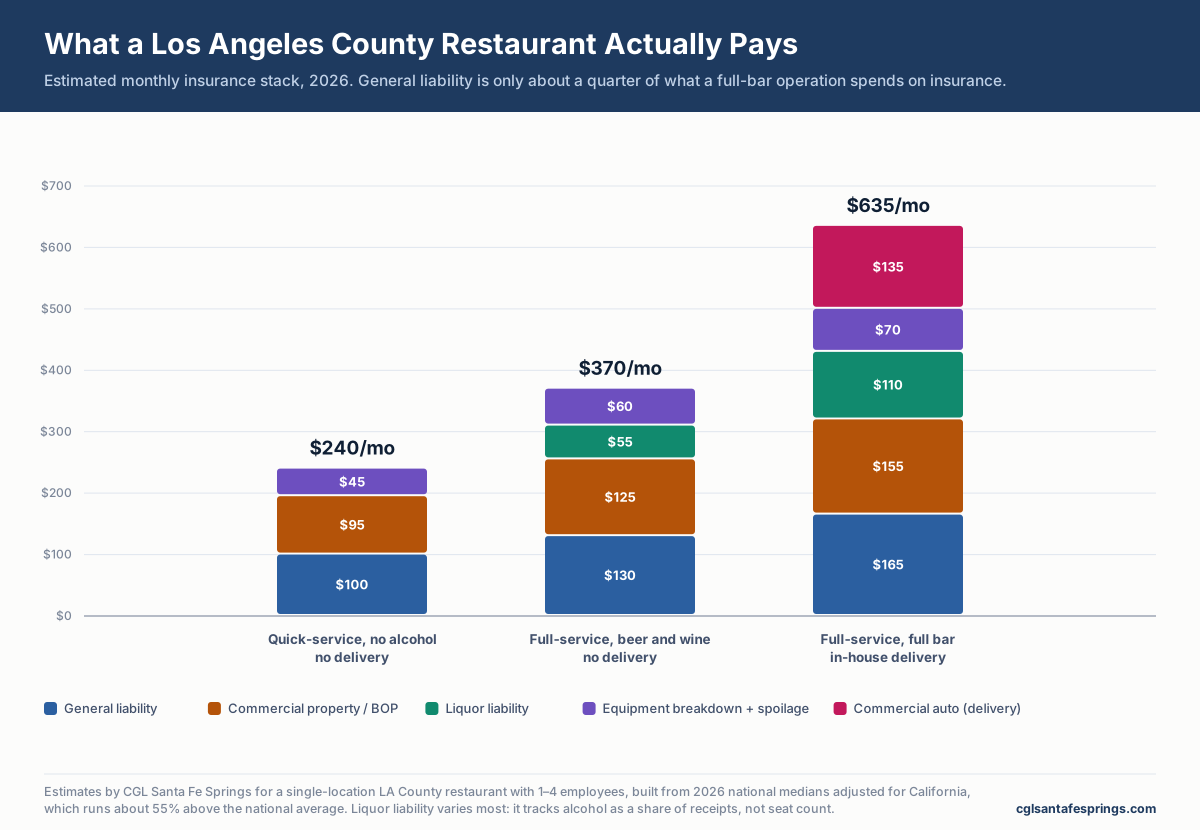
The pattern is the point. A quick-service restaurant with no alcohol and no delivery runs about $240 a month all in, and general liability is a bit over 40% of it. A full-service restaurant with a full bar and in-house delivery runs roughly $635, and general liability is about a quarter. Everything that grows the bill is something other than general liability: alcohol, equipment, refrigerated inventory, and vehicles.
MoneyGeek puts restaurant coverage at an average of $100 per month with ERGO NEXT and $124 with The Hartford, which lines up with the general liability layer here once California's roughly 55% loading over the national average is applied.
The California Alcohol Rule Most Owners Get Wrong
This is where restaurant owners in other states get advice that does not apply here, and where LA County operators can save real money if they understand it.
California is not a standard dram shop state. Under Business and Professions Code section 25602, the general rule is that the consumption of alcohol, not the serving of it, is the proximate cause of injuries an intoxicated person inflicts on someone else. A California restaurant that serves a visibly intoxicated adult who then causes a crash is generally immune from civil liability for that crash.
There is one significant exception, at Business and Professions Code section 25602.1: serving an obviously intoxicated minor. Serve someone under 21 who is already obviously intoxicated, and the immunity is gone. You can be sued for injuries or death that minor causes.
Two practical consequences:
Liquor liability in California is cheaper than in dram shop states, and it is still worth buying. The immunity covers civil liability for a third party's injuries. It does not cover assault and battery claims arising from a bar fight, over-service claims involving minors, or your own defense costs when someone sues anyway and you have to litigate the immunity. Defense costs alone justify the coverage.
Your ID policy is now an insurance control, not just a compliance one. The entire exception turns on age. A restaurant that can document a scan-every-ID policy and server training is managing the only exposure the statute leaves open.
Separately, serving an obviously intoxicated person of any age remains a misdemeanor. Criminal exposure is not affected by the civil immunity, and no policy covers it.
The Health Grade in Your Window
LA County requires a letter grade placard posted where customers can see it. The current system runs A for 90 to 100 points, B for 80 to 89, C for 70 to 79, and a numeric score card below 70. The county repainted the cards in 2022, so A is now green rather than blue and C is yellow rather than red, which still confuses regulars.
Between 2022 and 2024 the county issued over 120,000 grades: 96% were A, 3% were B, and under 0.5% were C. Score below 70 twice in twelve months and you close.
The insurance angle is not obvious but it is real. A B or C placard does not raise your general liability premium directly. What it does is give a plaintiff's attorney a documented, publicly posted county finding about your food handling practices, which is the first exhibit in a foodborne illness claim. Products-completed operations coverage under your general liability policy is what responds to a food poisoning claim, and how defensible that claim is depends heavily on your inspection history.
The Rankings
#1: ERGO NEXT
Best for: single-location quick service, cafes, bakeries, and coffee shops with no alcohol.
Next Insurance rebranded as ERGO NEXT in January 2026 following Munich Re's acquisition.
What stands out: roughly $100 a month, online in minutes, certificates from the app. A landlord in a Whittier or Downey strip center wanting proof of insurance before handover gets it same day.
Drawbacks: single-location only, and it does not solve alcohol. If you add a beer and wine license, you are adding a second carrier.
#2: The Hartford
Best for: full-service restaurants, anything with an ABC license, and any operation running its own delivery.
What stands out: the broadest single-carrier lineup for restaurants. General liability, liquor liability, food spoilage, equipment breakdown, and workers compensation under one policy with one renewal date and one audit. For a restaurant with a walk-in full of inventory, spoilage and equipment breakdown on the same paper as the liability is worth the premium difference.
Drawbacks: around $124 a month for the liability layer, above the digital carriers, and certificate turnaround runs 24 to 48 hours.
#3: CGL Santa Fe Springs
Best for: LA County restaurants that need the whole stack placed correctly, particularly with alcohol, delivery, or a landlord with a demanding insurance schedule.
What stands out: commercial leases in this county routinely require the landlord named as additional insured with primary and non-contributory wording and a waiver of subrogation. Getting that wrong delays a build-out. Same-day certificates with correct wording, plus market comparison across carriers that will write both the liability and the liquor line.
Drawbacks: Los Angeles County only.
#4: Thimble
Best for: pop-ups, farmers market stalls, catering gigs, and food events.
What stands out: buy coverage by the day, the job, or the month. If you run four catering events a year, an annual policy is the wrong product and this is the right one.
Drawbacks: no standalone liquor liability, limited depth, and claims handled by third-party carriers. Not a fit for a permanent location.
#5: Travelers
Best for: multi-unit operators and restaurants with real financials.
What stands out: strong on the property and business income side, which is where a restaurant's largest single loss usually comes from. A kitchen fire that closes you for three months is a business income claim, not a liability one.
Drawbacks: selective underwriting, and generally not interested in a first-year single location.
#6: FLIP (Food Liability Insurance Program)
Best for: food trucks, caterers, and vendors who need coverage fast and cheap for a specific event.
What stands out: built for exactly this niche, with event-specific certificates that venue coordinators accept.
Drawbacks: narrow. A brick-and-mortar full-service restaurant needs more than this.
#7: Nationwide
Best for: owners who want a local agent to walk the building with them.
Drawbacks: priced above the digital options for straightforward risks, and quality varies by agent.
#8: biBERK
Best for: price-first buyers with a simple, alcohol-free operation.
Drawbacks: no agent, so nothing to call when a landlord demands specific endorsement wording, and restaurant appetite in California is narrow.
#9: Progressive Commercial
Best for: restaurants whose delivery fleet is the dominant exposure.
What stands out: commercial auto is their strength, and with auto rates running +7% to +20% in 2026 that line deserves attention.
Drawbacks: the general liability side is standardized with little endorsement flexibility.
#10: State Farm Business
Best for: existing State Farm customers who want one agent.
Drawbacks: commercial is an add-on to a personal lines platform. Slowest certificate turnaround here.
Coverage a Restaurant Needs Beyond General Liability
| Coverage | What it pays for | Who needs it |
|---|---|---|
| General liability | Customer slip and fall, foodborne illness, damage to others' property | Every restaurant |
| Liquor liability | Assault and battery, over-service involving minors, defense costs | Anyone with an ABC license |
| Commercial property / BOP | Your building, contents, kitchen equipment | Every restaurant |
| Business income | Revenue lost while closed after a covered loss | Every restaurant, and usually underbought |
| Equipment breakdown | Compressor, walk-in, HVAC, fryer failures | Anyone with refrigeration |
| Food spoilage | Inventory lost to an outage or equipment failure | Anyone with a walk-in |
| Workers compensation | Employee burns, cuts, slips | Required from your first employee |
| Commercial auto / hired and non-owned | Delivery accidents, including staff using their own cars | Anyone delivering |
| EPLI | Wage and hour, harassment, wrongful termination claims | Anyone with employees in California |
The two most commonly underbought are business income and hired and non-owned auto. Business income because owners estimate a month of closure when a kitchen fire means three or four. Hired and non-owned because if a server runs a delivery in their own car and hits someone, your business gets named in the suit and your commercial auto policy does not respond unless you bought that endorsement.
How to Choose
Quick service, no alcohol, one location: ERGO NEXT. Done in ten minutes.
Full service with beer and wine or a full bar: The Hartford, or an agent who will place liability and liquor together and read your lease's insurance schedule.
Catering, pop-ups, events: Thimble or FLIP by the event.
Delivery in house: whoever gets the auto line right, because that is the fastest-rising cost on your bill.
Frequently Asked Questions
How much does general liability insurance cost for a restaurant in Los Angeles County?
Roughly $100 to $165 per month for the general liability layer alone on a single-location restaurant with one to four employees, depending on alcohol service, delivery, and customer volume. The full insurance stack is what matters: about $240 a month all in for quick service with no alcohol, and around $635 for a full-service restaurant with a full bar and in-house delivery. California runs about 55% above the national average, so national quotes need adjusting upward.
Does California have dram shop liability for restaurants?
Not in the usual sense. Under Business and Professions Code section 25602, California treats the consumption of alcohol rather than the serving of it as the proximate cause of injury, so a restaurant that serves a visibly intoxicated adult is generally immune from civil liability for what that person later does. The exception at section 25602.1 is serving an obviously intoxicated minor, where immunity is lost. Liquor liability coverage is still worth buying because the immunity does not cover assault and battery claims, minor-related claims, or your defense costs.
Does a B or C health grade affect my restaurant insurance?
Not directly at renewal, but it matters when a claim happens. LA County posts letter grades publicly, with A at 90 to 100 points, B at 80 to 89 and C at 70 to 79. A downgraded placard becomes documentary evidence in a foodborne illness claim against your products-completed operations coverage. Two scores below 70 within twelve months also triggers closure, which becomes a business income question rather than a liability one.
Do I need commercial auto if my staff deliver in their own cars?
Yes, in the form of hired and non-owned auto liability. Your personal auto policy will not cover an employee's delivery run, and your general liability policy excludes auto exposure entirely. Without a hired and non-owned endorsement, an accident during a delivery leaves your business named in the suit with no policy responding. This is one of the most common gaps in restaurant programs, and it got much more common when delivery became standard.
What insurance does my LA County landlord actually require?
Most commercial leases here require $1 million per occurrence and $2 million general aggregate, the landlord and its property manager named as additional insured, primary and non-contributory wording, a waiver of subrogation, and thirty days notice of cancellation. Many also require liquor liability if you serve alcohol and proof of workers compensation. Read the insurance schedule before signing, because the endorsements it names are what determine your premium, and a certificate missing one of them will hold up your build-out.


