
Most contractor insurance rankings are written by people who have never had a quote declined. They compare price, app quality, and brand recognition, which is fine if you are a bookkeeper. If you hold a C-39 or a C-12, none of that matters, because half the providers on those lists will not quote you at all.
This ranking is organized around the thing that actually decides your outcome: appetite. Which markets write your CSLB classification, at what price, and what they will demand before they bind. If you need the coverage basics first, start with our guide to general liability for California contractors, then come back here to choose a provider.
The short answer: for low-hazard trades like painting, flooring, and landscaping, ERGO NEXT (the rebranded Next Insurance) is the fastest and cheapest route and you can be done in ten minutes. For the mechanical trades, The Hartford and Travelers are the strongest admitted options. For roofing, framing, excavation, and anyone with a claim in the last three years, you are going to surplus lines and you need a broker who knows those markets. CGL Santa Fe Springs ranks second overall and first for LA County contractors who need certificates that clear a permit counter the same day.
How We Ranked These
- •Appetite by CSLB classification -- will they write your license class at all, and at what revenue?
- •Certificate turnaround and endorsement accuracy -- can they issue CG 20 10 and CG 20 37 with the right entity named, today?
- •Admitted vs surplus lines -- admitted carriers are backed by the California Insurance Guarantee Association; surplus lines placements are not, and add a 3% California surplus lines tax plus a stamping fee.
- •Subcontractor and payroll audit handling -- the number on your renewal is set at audit, not at binding.
- •Price against California benchmarks -- California general liability runs about 55% above the national average, so national quotes need translating.
- •Compliance knowledge -- does anyone there understand CSLB requirements well enough to keep your license clean?
The Appetite Problem Nobody Puts in a Ranking
Here is what the comparison sites leave out. Your classification, not your price sensitivity, determines which of these providers will even return a quote.
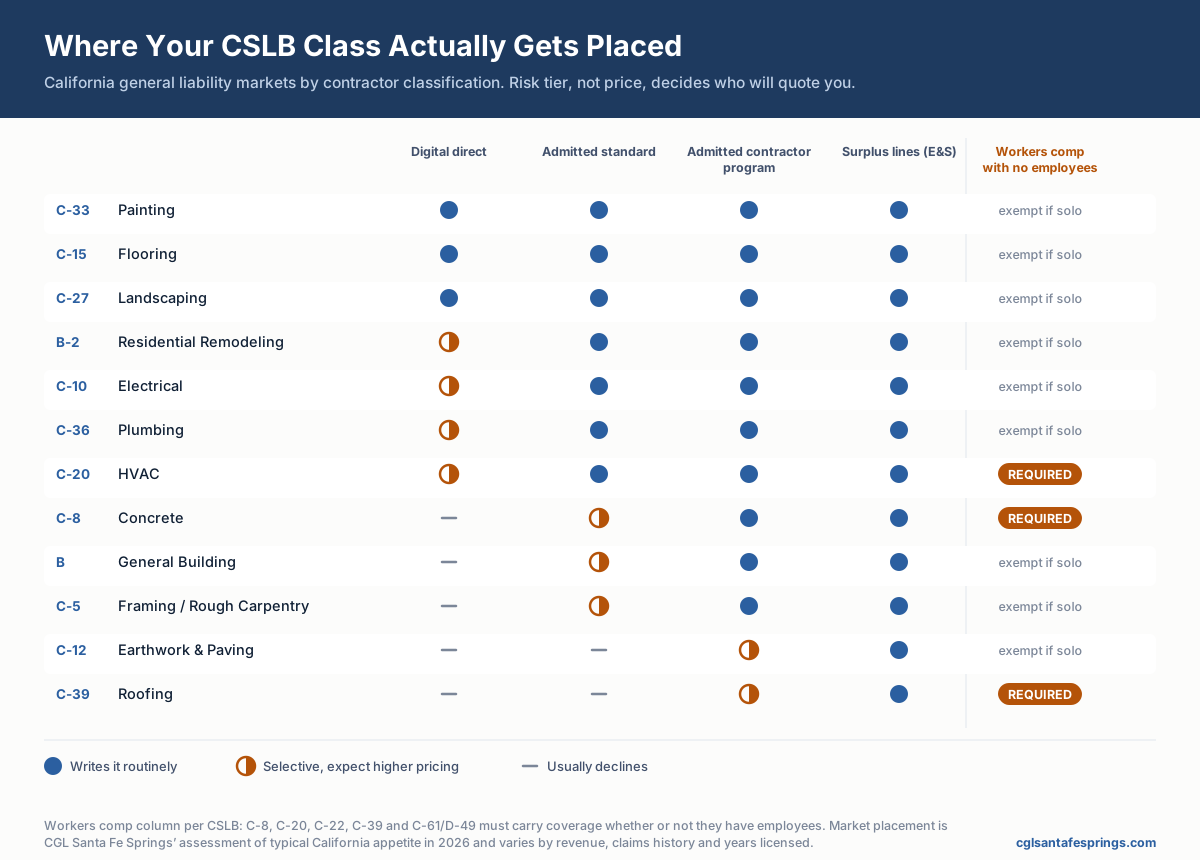
Two things fall out of that grid.
First, the digital-direct carriers are excellent right up until they are useless. If you are a C-33 painter doing $400,000 in residential repaints, the online route is genuinely the best answer. If you are a B general building contractor running subs on commercial tenant improvements, the automated underwriting will either decline you or issue something that does not match your contract requirements.
Second, the workers compensation column is not optional reading. Per the CSLB, C-8 concrete, C-20 HVAC, C-22 asbestos, C-39 roofing, and C-61/D-49 tree service licensees must carry workers compensation whether or not they have employees. There is no solo exemption for those five. Under SB 216, that mandate extends to every remaining classification by January 1, 2028. Contractors who have run solo without coverage for twenty years are going to find out about this at renewal.
The Rankings
#1: ERGO NEXT (formerly Next Insurance)
Best for: C-33, C-15, C-27, and other low-hazard trades under roughly $1M in revenue, with no subcontractors.
Next Insurance rebranded as ERGO NEXT in January 2026 after Munich Re completed its acquisition and folded the company into ERGO Group. Same Palo Alto operation, same platform, much larger balance sheet behind it. Most comparison pages still call it Next.
What stands out: Quote to certificate in about ten minutes, unlimited COIs from the dashboard at any hour. For a painter who needs proof of insurance to start Monday, nothing beats it.
Drawbacks: Appetite narrows sharply as hazard rises. Custom endorsement wording is a support ticket, not a phone call.
#2: CGL Santa Fe Springs
Best for: Contractors working Santa Fe Springs, Whittier, Norwalk, Downey, Pico Rivera, Bellflower, Paramount, Bell Gardens, Artesia, Hawaiian Gardens, and Long Beach.
Why second overall and first locally: market access across admitted contractor programs and surplus lines, combined with same-day certificates written to the wording a specific permit counter or general contractor demands. On a tenant improvement in the Santa Fe Springs industrial corridor, the certificate is the thing that stops the job, not the premium.
What stands out: CSLB-aware placement. An LLC contractor needs at least $1M in liability coverage for five or fewer members, rising $100,000 per additional member to a $5M cap. Getting handed a $500,000 policy puts the license out of compliance, and automated platforms do not check.
Drawbacks: Los Angeles County only.
#3: The Hartford
Best for: C-10, C-36, C-20 and B licensees with employees, running $1M to $10M.
What stands out: One of the deepest classification libraries in admitted commercial lines, strong completed operations language, and claims infrastructure built for litigated Southern California claims. General contractors recognize the paper, which matters at prequalification.
Drawbacks: Priced above the digital carriers. Certificate turnaround runs 24 to 48 hours, which is a real problem mid-week.
#4: Travelers
Best for: Established contractors with clean loss runs who need a carrier name that clears GC prequalification without a conversation.
What stands out: Long-standing construction appetite and a well-understood endorsement library. Their contractor programs handle per-project aggregates cleanly, which most LA County commercial contracts now require.
Drawbacks: Selective. Newer licensees, anyone with a claim in the last three years, and most roofing operations get steered elsewhere.
#5: Nationwide
Best for: Contractors who want an agent within driving distance and are willing to pay a little for it.
What stands out: Dense Southern California agent network and a claims process that takes small commercial accounts seriously.
Drawbacks: Quality varies enormously by agent. Ask what share of their book is commercial construction before you commit.
#6: Farmers Insurance
Best for: Owner-operators who value the relationship over the last $200 of annual premium.
What stands out: Woodland Hills headquarters and one of the densest agent footprints in the region. A Farmers agent who writes contractors regularly knows your city's requirements as well as any platform.
Drawbacks: Same agent-variance problem as Nationwide, more pronounced. An agent whose book is mostly personal auto will not serve a C-12 well.
#7: biBERK
Best for: Solo low-hazard operators where price is the only variable and no contract dictates wording.
What stands out: Direct model backed by Berkshire Hathaway, no agent commission, often the lowest number on a clean risk.
Drawbacks: No agent means no one to call when a contract demands specific endorsements. California construction appetite is narrow.
#8: Thimble
Best for: Seasonal or job-by-job work where you do not want an annual policy.
What stands out: Coverage by the job, day, month, or year. Genuinely useful for a contractor who works six months a year or needs coverage for one commercial job.
Drawbacks: Claims are handled by third-party carriers. Per-job policies rarely satisfy a GC that wants continuous coverage with a per-project aggregate.
#9: Surplus lines through a wholesale broker
Best for: C-39 roofing, C-12 excavation, C-5 framing, demolition, and any contractor with a recent loss.
What stands out: This is not a brand, it is the market of last resort and the only market for hard classes. Carriers write through wholesalers, so you reach them through a retail agent who has the appointments.
Drawbacks: No CIGA backstop, 3% California surplus lines tax plus a stamping fee, and forms that are manuscripted rather than standard. Read the exclusions, because they are not the ISO ones you know.
#10: State Farm Business
Best for: Existing State Farm personal lines customers who want one agent for everything.
Drawbacks: The platform is built around personal lines with commercial as an add-on. Standalone contractor general liability pricing runs above market and certificate turnaround is the slowest here.
What Contractors Actually Pay in Los Angeles County
| CSLB class | Trade | Typical monthly | Typical annual | Usual market |
|---|---|---|---|---|
| C-33 | Painting | $90 - $190 | $1,080 - $2,280 | Digital or admitted |
| C-15 | Flooring | $95 - $200 | $1,140 - $2,400 | Digital or admitted |
| C-27 | Landscaping | $85 - $185 | $1,020 - $2,220 | Digital or admitted |
| B-2 | Residential Remodeling | $95 - $205 | $1,140 - $2,460 | Admitted |
| C-10 | Electrical | $120 - $260 | $1,440 - $3,120 | Admitted |
| C-36 | Plumbing | $140 - $310 | $1,680 - $3,720 | Admitted |
| C-20 | HVAC | $135 - $300 | $1,620 - $3,600 | Admitted |
| B | General Building | $190 - $520 | $2,280 - $6,240 | Admitted specialty |
| C-5 | Framing | $210 - $480 | $2,520 - $5,760 | Specialty or E&S |
| C-12 | Earthwork & Paving | $290 - $700 | $3,480 - $8,400 | E&S |
| C-39 | Roofing | $330 - $780 | $3,960 - $9,360 | E&S |
Ranges assume one to four employees, no open claims, and $1M per occurrence with a $2M general aggregate. ConstructionCoverage puts California contractor policies at $2,200 to $4,500 annually against $750 to $2,500 nationally, which is the same 55% California loading seen across every trade.
The Audit Is Where Contractors Lose Money
Every provider on this list rates contractors on payroll, revenue, or both, and every one of them audits. The largest surprise on a contractor's bill is almost never the premium quoted at binding. It is the audit invoice that arrives four months after the policy ends.
The mechanism is simple. If you paid a subcontractor and cannot produce a certificate showing they carried their own general liability for the period they worked for you, the auditor adds that payment to your payroll and charges you for it at your rate. A general building contractor who ran $300,000 through uninsured subs can see a five-figure audit bill.
Collect certificates before the sub starts, not at audit. Keep them for the policy period plus the completed operations tail. This one habit is worth more than any premium you will save shopping.
2026 Market Conditions
- •General liability: flat to about +10%, steepest in residential construction and street and road work
- •Excess and umbrella: +5% to +30%, with lead $1M to $2M layers firm
- •Commercial auto: +7% to +20%, still the hardest line in the market
- •Commercial property: down 5% to 20% as reinsurance capital returned
- •Workers compensation: flat to +3%
For a contractor with trucks, the auto line is where the budget goes this year, not general liability. Do not let a soft property market talk you into consolidating everything with a carrier whose liability appetite is wrong for your class.
How to Choose
Low-hazard trade, no subs, under $1M: ERGO NEXT or biBERK. Ten minutes, done.
Mechanical trades with employees: The Hartford or Travelers through an agent who will handle your endorsements.
Roofing, framing, excavation, or a recent claim: a retail agent with wholesale market access. The digital carriers are not an option and applying to them just wastes a week.
Working in LA County and pulling permits: whoever can put correct wording on a certificate today. That is the constraint that costs you money here.
Frequently Asked Questions
Does the CSLB require general liability insurance for contractors?
Not for every license type. The CSLB requires a $25,000 license bond for all contractors and requires general liability specifically for LLCs: at least $1 million for licensees with five or fewer members, plus $100,000 for each additional member up to a $5 million cap. Separately, workers compensation is mandatory regardless of employees for C-8, C-20, C-22, C-39 and C-61/D-49 licensees, and SB 216 extends that to all classifications by January 1, 2028. In practice, nearly every commercial contract, municipal permit, and commercial landlord in Los Angeles County requires general liability whatever your entity type.
Why did three carriers decline to quote my roofing business?
Roofing is the hardest common class to place in California. Work at height, water intrusion claims that surface years after the job, and a completed operations tail measured in years mean most admitted carriers simply do not write it. That is an appetite decision made at the underwriting-guideline level, not a judgment about your business. The answer is a retail agent with surplus lines access, not more online applications.
What is the difference between an admitted and a surplus lines policy for contractors?
Admitted carriers file their rates and forms with the California Department of Insurance and are backed by the California Insurance Guarantee Association if the carrier fails. Surplus lines carriers are not backed by CIGA, their forms are often manuscripted rather than standard ISO, and the placement carries a 3% California surplus lines tax plus a stamping fee. Admitted is preferable when you can get it. For hard classes it is not available, and a surplus lines policy is far better than no policy.
How much general liability insurance do LA County contractors need?
$1 million per occurrence and $2 million general aggregate is the baseline nearly every contract and permit requires. Commercial projects, municipal work, and institutional clients commonly require $2 million per occurrence or a $5 million umbrella above the primary. Many LA County commercial contracts now also require a per-project aggregate, which typically adds 10% to 25% to the premium, so read the insurance schedule before you bid rather than after you win.
Can I switch carriers mid-policy if I find a cheaper quote?
You can cancel and rewrite, but check three things first. Occurrence policies cover claims from incidents during the policy period even after cancellation, so your tail is intact. Any certificate you issued naming an additional insured is tied to the policy you are cancelling, so those parties need new certificates. And a mid-term cancellation triggers an audit, which may produce a bill that erases the savings. Switching at renewal is almost always cleaner.

