
If you hold a C-39 and you have been told no by three carriers this month, nothing is wrong with your business. Roofing is the hardest common classification to place in California, and most of the providers that dominate "best small business insurance" lists do not write it at any price.
This ranking only covers markets that will actually quote a California roofing contractor in 2026. For coverage details and a quote on general liability for roofing contractors, see our roofing page.
The short answer: most C-39 operations end up in surplus lines, reached through a retail agent with wholesale appointments. ERGO NEXT will quote smaller residential roofers and is the fastest option when it works. The Hartford is the strongest admitted market for established operations with clean loss runs. CGL Santa Fe Springs ranks first for roofers working Southeast LA County because it has both the market access and the certificate turnaround. Expect $330 to $780 per month for a solo-to-small operation, and considerably more once you have a crew.
Why Roofing Is Priced the Way It Is
Four things drive it, and they compound:
- •Work at height. The severity of a fall claim involving a third party is open-ended.
- •Water intrusion. A roof that fails does not damage the roof, it damages everything under it. Interior finishes, inventory, tenant business income.
- •The completed operations tail. Your work sits there for years. A leak that shows up in year three is still your claim, which is why completed operations coverage is the endorsement that matters most in this trade.
- •Carrier concentration. Because of the first three, few admitted carriers write roofing, so there is no competitive pressure holding prices down.
MoneyGeek's 2026 roofing analysis puts general liability for roofing businesses at an average of $652 per month across the providers it examined, the largest single insurance line a roofing company carries alongside workers compensation.
The Southern California Roofing Calendar
This is the part a broker in Ohio cannot price for you. Roofing exposure in this county is seasonal in a specific, predictable way, and it maps onto the local climate almost exactly.
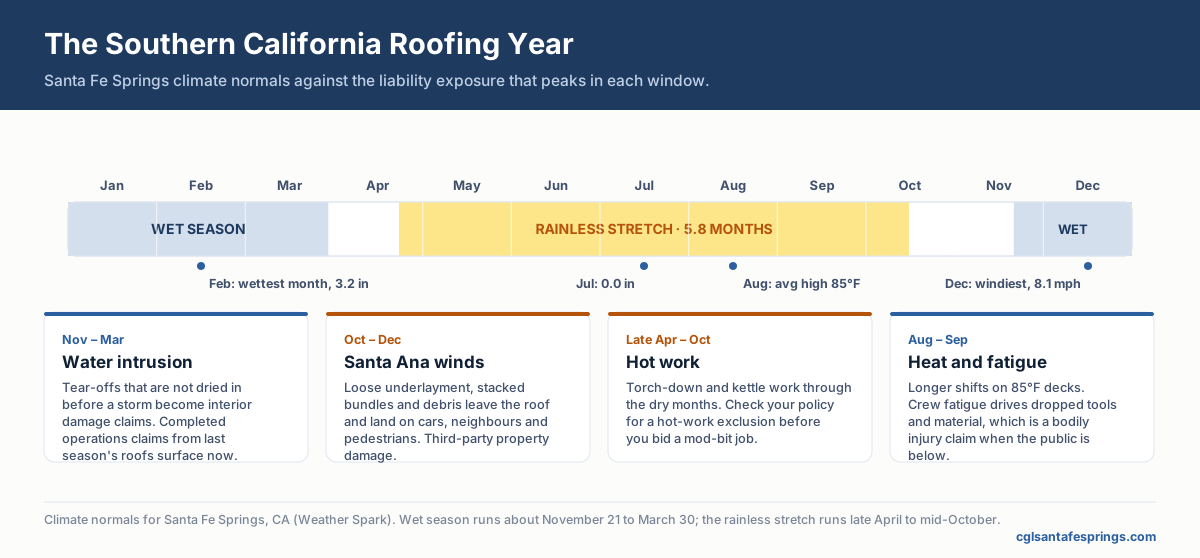
Santa Fe Springs runs a rainless stretch of about 5.8 months from late April into mid-October, a wet season from roughly November 21 through March 30 with February the wettest month at about 3.2 inches, an August average high near 85 degrees, and December as the windiest month at 8.1 mph average.
What that means in practice:
The dry-in window is the whole game. From May through September you can tear off a roof with almost no weather risk, which is why everyone schedules then. The exposure is that crews get comfortable. The first storm after a five-month dry spell arrives on a schedule nobody has thought about since April, and a roof that is torn off but not dried in becomes an interior water damage claim overnight.
Santa Ana season overlaps the end of the busy season. October through December, offshore winds hit while crews are still finishing the backlog. Loose underlayment, stacked bundles on a deck, and debris come off the roof and land on cars, neighboring property, and people. That is third-party property damage, and it is a general liability claim, not a property claim.
Hot work runs all summer. Torch-down and kettle work on mod-bit and built-up roofs happens through the dry months. Check your policy for a hot-work exclusion before you bid a job that needs it. Some E&S forms exclude it outright, others require a fire watch for a set period after work stops, and a violated warranty is a denied claim.
Where a C-39 Actually Gets Placed
| Market | Will it write C-39? | Typical use | Trade-off |
|---|---|---|---|
| Digital direct (biBERK, Thimble) | Rarely in California | Not a practical route for most roofers | Applications usually decline at classification |
| ERGO NEXT | Smaller residential operations | Fast bind, instant COIs | Appetite caps out quickly by revenue and crew size |
| The Hartford | Established operations, clean loss runs | Strongest admitted option | Selective; 24 to 48 hour COI turnaround |
| Admitted contractor programs | Some, with underwriting | Mid-size operations | Requires an agent with the appointment |
| Surplus lines via wholesaler | Yes, this is the main market | Most C-39 operations | No CIGA backstop, 3% CA surplus lines tax plus stamping fee, manuscripted forms |
The Rankings
#1: CGL Santa Fe Springs
Best for: C-39 contractors working Whittier, Norwalk, Downey, Pico Rivera, Santa Fe Springs, Bellflower, Paramount, and Long Beach.
Why first: roofing is a placement problem before it is a price problem. A retail agent with both admitted contractor programs and surplus lines access can actually get you quoted, and same-day certificates written to the exact wording a GC or permit counter demands keep the crew working.
What stands out: the roofing-specific endorsements get read, not assumed. Hot work, per-project aggregate, completed operations tail length, and whether the tract builder's insurance schedule wants CG 20 37 by name.
Drawbacks: Los Angeles County only.
#2: The Hartford
Best for: roofing companies with two or more crews, three years of clean loss runs, and real financials.
What stands out: the strongest admitted paper a roofer is likely to get. Deep completed operations language and claims handling built for litigated Southern California water damage claims, which is exactly the claim you will have.
Drawbacks: they will decline plenty of applicants. New licensees and anyone with a paid claim in three years should not expect a quote.
#3: Surplus lines through a wholesale broker
Best for: most C-39 operations in California. Realistically this is where you land.
What stands out: it is the only market with genuine roofing capacity. Limits, per-project aggregates, and hot-work terms are all available if you are willing to pay for them.
Drawbacks: no CIGA backstop if the carrier fails. The 3% surplus lines tax and stamping fee sit on top of premium. Most importantly the forms are manuscripted, so the exclusions are not the ISO ones you have read before. Have someone read the actual policy, not the quote summary.
#4: ERGO NEXT
Best for: owner-operator residential roofers under roughly $500,000 in revenue with no employees.
Next Insurance rebranded as ERGO NEXT in January 2026 after Munich Re's acquisition. When it quotes a roofer, it is fast and the price is competitive.
Drawbacks: appetite is tight and it tightens further in California. Growing past a couple of employees usually means moving markets anyway.
#5: Thimble
Best for: roofers with genuinely seasonal or project-based workloads who do not want twelve months of premium.
Drawbacks: claims go through third-party carriers, and a job-by-job policy will not satisfy a builder that wants continuous coverage with a per-project aggregate. Fine for repair work, not for tract or commercial jobs.
#6 through #10: the ones that will not quote you
Hiscox, biBERK, Progressive Commercial, State Farm Business, and most bank-affiliated commercial programs either exclude roofing outright in California or price it so far above market that it is not a real offer. They belong on this list only so you stop spending afternoons applying to them.
The Workers Compensation Rule That Catches Solo Roofers
C-39 is one of five classifications where workers compensation is mandatory regardless of employees. Per the CSLB, C-8 concrete, C-20 HVAC, C-22 asbestos, C-39 roofing, and C-61/D-49 tree service licensees must carry coverage or a valid Certification of Self-Insurance whether or not they employ anyone. There is no solo exemption.
Coverage must be continuous. A lapse suspends the license, and a suspended license during a job is a contract breach, not just a paperwork problem. Roofing workers compensation in California runs roughly $20 to $40 per $100 of payroll, among the highest rates in construction, which is why some roofers try to run without it. Under SB 216 the same mandate reaches every remaining CSLB classification by January 1, 2028.
What Underwriters Ask a Roofer
Have these ready before you apply. Vague answers get declined more often than bad answers.
| Question | Why they ask | What helps |
|---|---|---|
| Residential, commercial, or both? | Commercial and tract work carry different severity | Precise revenue split by percentage |
| Percentage of work over two stories? | Height drives severity | An honest number, not "rarely" |
| Any hot work, torch-down, or kettle? | Fire exposure and warranty terms | Your written hot-work procedure |
| Subcontractors used? | Uninsured subs get charged to your payroll | Certificates on file for every sub |
| New roofs or repairs? | Repair work has a shorter tail | Percentage split |
| Five-year loss runs | Frequency matters more than severity | Runs from every prior carrier, no gaps |
| Tear-off and dry-in procedure | The single biggest water claim driver | Written procedure with a same-day dry-in rule |
That last one is worth real money. A roofer who can show an underwriter a written policy that every tear-off gets dried in the same day, with no exceptions between November and March, is presenting a fundamentally different risk than one who cannot.
How to Choose
Solo residential roofer, small revenue: try ERGO NEXT first. If it declines, go straight to a retail agent, do not keep applying online.
Two or more crews, clean loss runs: have an agent try The Hartford and the admitted contractor programs before accepting surplus lines.
Any claim in the last three years, or commercial and tract work: surplus lines through a wholesaler. Budget for it and get the policy read.
Working LA County permits: whoever gets you a correct certificate today. In a trade where the weather sets your schedule, a week lost to a rejected COI in October is a week you do not get back before the rain.
Frequently Asked Questions
Why is general liability insurance so expensive for roofers?
Roofing combines the two things underwriters price hardest: severity and duration. A fall or a falling-material claim involving a third party has no natural ceiling, and a roof failure damages everything underneath it rather than just the roof. On top of that, your completed operations tail runs for years, so a leak discovered in year three is still your claim. Because few carriers will accept that combination, there is little competition holding prices down. Expect $330 to $780 per month for a small California operation, more with crews.
Do C-39 roofing contractors in California need workers compensation with no employees?
Yes. C-39 is one of five CSLB classifications, along with C-8 concrete, C-20 HVAC, C-22 asbestos, and C-61/D-49 tree service, that must carry workers compensation or a valid Certification of Self-Insurance whether or not they have employees. There is no solo exemption, coverage must be continuous, and a lapse suspends the license. Under SB 216 the requirement reaches every remaining classification by January 1, 2028.
Which insurance companies actually write roofing contractors in California?
The realistic markets are surplus lines carriers reached through a wholesale broker, a small number of admitted contractor programs, The Hartford for established operations with clean loss runs, and ERGO NEXT for smaller residential operators. Hiscox, biBERK, Progressive Commercial and most bank-affiliated programs either exclude roofing in California or price it out of contention. If three carriers have declined you, that is an appetite guideline, not a comment on your business, and the fix is an agent with wholesale access.
What is a hot-work exclusion and does it affect my roofing policy?
Hot work means torch-down, kettles, welding, or anything else producing flame or high heat. Many roofing policies, particularly surplus lines forms, either exclude hot work entirely or cover it only if you follow specific conditions, usually a fire watch maintained for a set period after work stops. If you bid mod-bit or built-up roofing, confirm the hot-work terms in the actual policy before you sign the contract. A violated warranty produces a denied claim on exactly the loss you bought the policy for.
Should a roofer buy a per-project aggregate?
If you work for general contractors or builders, usually yes, and often the contract requires it. A standard $2 million general aggregate is shared across every job you touch in the policy year, so two bad claims early can exhaust it and leave your remaining projects effectively uninsured. A per-project aggregate gives each job its own limit. It typically adds 10% to 25% to premium, which is cheap relative to being unable to satisfy an insurance schedule mid-contract.

